Risorse di calcolo sezione di Informatica
Descrizione
L’infrastruttura di calcolo della sezione di Informatica è composta in prevalenza da sistemi virtualizzati, che si appoggiano su vari server fisici.
Su questa infrastruttura vengono ospitate le macchine virtuali dedicate ai progetti di ricerca, i servizi specifici per il corso di laurea di Informatica, alcuni servizi che la sezione fornisce al Dipartimento DiSIT, più eventuali macchine dedicate per esigenze particolari durante tesi o stage interni, e infine i servizi di gestione e monitoraggio.
Storage e backup hanno delle macchine dedicate. Alcuni progetti di ricerca hanno a disposizione delle macchine a loro uso esclusivo.
Sintesi delle risorse hardware disponibili
Complessivamente sono a disposizione per le attività descritte in precedenza:
- Cpu: 716 cores, 1296 threads
- Ram: 4080 GB
- Raw Storage: ~510 TB
- GPU cards: 3
- GPU memory: 112 GB
Essendo CPU molto diverse fra di loro, il conteggio totale ha poco significato, perché quelle nuove sono molto più efficienti di quelle vecchie.
Anche per la RAM vale il discorso fatto per le CPU, la memoria delle macchine nuove è più veloce della memoria dei sistemi più vecchi.
Lo spazio reale a disposizione ovviamente dipende dalla ridondanza adottata sui vari sistemi; laddove c’è un RAID 1/10 si dimezza la capacità, con un RAID 5/50 si deve sottrarre lo spazio dedicato alla parità, etc.
Dettaglio hardware
Elenco delle schede GPU per il calcolo parallelo:
- 2 Nvidia L40 (48 GB)
- 1 Nvidia T4 (16 GB)
Elenco dettagliato delle macchine a disposizione, con anno di acquisto, e delle loro caratteristiche:
- 2025 ladybug - HPE ProLiant DL560 Gen11 - 4x Intel(R) Xeon(R) Gold 6418H (24 cores, 96 totali, 192 threads) - 1 TB (16x 64 GB DDR5) - 2x 1.92 TB SSD - 5x 7.68 TB SSD
- 2025 rampage - HPE ProLiant DL560 Gen11 - 4x Intel(R) Xeon(R) Gold 6418H (24 cores, 96 totali, 192 threads) - 1 TB (16x 64 GB DDR5) - 2x 1.92 TB SSD - 5x 7.68 TB SSD
- 2023 amidar - Lenovo ThinkSystem SR650 v2 - 2x Intel(R) Xeon(R) Silver 4310 CPU @ 2.10GHz - 3.30 GHz (12 cores, 24 threads, 48 totals) - 128 GB (4x 32 GB DDR4) - 2x 960GB M.2 NVMe SSD
- 2023 NAShero16 - QNAP TS-h1677XU-RP - AMD Ryzen 7 3700X @ 4.4 GHz turbo (8 cores, 16 threads) - 32 GB (2x 16 GB) - 16x Seagate 16 TB SATA 3.5” ST16000NM001G-2KK103
- 2022 len1 - Lenovo ThinkSystem SR590 - 2x Xeon Silver 4208 @ 2.1 GHz (8 cores, 16 totali, 32 threads) - 128 GB (4x 32 GB DDR4 2933 MHz) - 2x 300 GB SAS 3.5” 10 kRPM + 4x 8 TB SAS 3.5” 7.2 kRPM
- 2022 len2 - Lenovo ThinkSystem SR590 - 2x Xeon Silver 4208 @ 2.1 GHz (8 cores, 16 totali, 32 threads) - 128 GB (4x 32 GB DDR4 2933 MHz) - 2x 300 GB SAS 3.5” 10 kRPM + 4x 8 TB SAS 3.5” 7.2 kRPM
- 2022 len3 - Lenovo ThinkSystem SR590 - 2x Xeon Silver 4208 @ 2.1 GHz (8 cores, 16 totali, 32 threads) - 128 GB (4x 32 GB DDR4 2933 MHz) - 2x 300 GB SAS 3.5” 10 kRPM + 4x 8 TB SAS 3.5” 7.2 kRPM
- 2021 Wing - Dell PowerEdge R740xd - 2x Xeon Gold 6238R CPU @ 2.2 GHz (28 cores, 56 totals, 112 threads) - 128 GB (2x 64 GB DDR4) - 2x SDD 960 GB - 1 NVMe 1600 GB
- 2021 Rainbow - Dell PowerEdge R740xd - 2x Xeon Gold 6238R CPU @ 2.2 GHz (28 cores, 56 totals, 112 threads) - 128 GB (2x 64 GB DDR4) - 2x SDD 960 GB - 1 NVMe 1600 GB
- 2021 Dust - Dell PowerEdge R740xd - 2x Xeon Gold 6238R CPU @ 2.2 GHz (28 cores, 56 totals, 112 threads) - 128 GB (2x 64 GB DDR4) - 2x SDD 960 GB - 1 NVMe 1600 GB
- 2021 Elettra - Dell PowerEdge R740xd - 2x Xeon Gold 6238R CPU @ 2.2 GHz (28 cores, 56 totals, 112 threads) - 128 GB (2x 64 GB DDR-4) - 2x SDD 960 GB - 2x SSD 1600 GB
- 2017 Pong Dell R730 XD - 2x Intel(R) Xeon(R) CPU E5-2620 v4 @ 2.10GHz (8 cores, 16 threads, 32 totals) - 128 GB (8x 16 GB DDR4 DIMM 2400 MHz running at 2133 MHz, 16 free slots) - [2x 300 GB removed] - 12x 1 TB 2.5” SAS (SEAGATE ST1000NX0453)
- 2016 Fatboy - Dell R730 XD - 1x XEON E5-2620 v4 @ 2.1 Ghz (8 cores, 16 threads, 16 totals) (1 free socket) - 32 GB (2x 16 GB, 22 free slots) - 2x 300 GB + 22x 1 TB
- 2014 Even - Dell R620 - 1x XEON E5-2640 v2 @ 2 GHz (6 cores, 12 threads) (1 free socket) - 32 GB (2x 16 GB, 22 free slots) - 8x 1 TB
- 2014 Baby - Dell R620 - 2x XEON E5-2640 v2 @ 2 GHz (6 cores, 12 threads, 24 totals) - 128 GB (8x 16 GB, 16 free slots) - 8x 300 GB
- 2014? Quark9 Supermicro SC842 - Xeon(R) CPU E5-1650 v2 @ 3.50 GHz (6 cores, 12 threads) - 16 GB - 1x 1 TB
- 2014? Quark8 Supermicro SC842 - Xeon(R) CPU E5-1650 v2 @ 3.50 GHz (6 cores, 12 threads) - 16 GB - 1x 1 TB
- 2014? Quark7 Supermicro SC842 - Xeon(R) CPU E5-1650 v2 @ 3.50 GHz (6 cores, 12 threads) - 16 GB - 1x 1 TB
- 2014? Quark5 Supermicro SC842 - Xeon(R) CPU E5-1650 v2 @ 3.50 GHz (6 cores, 12 threads) - 16 GB - 1x 1 TB
- 2014? Quark4 Supermicro SC842 - Xeon(R) CPU E5-1650 v2 @ 3.50 GHz (6 cores, 12 threads) - 16 GB - 1x 1 TB
- 2014? Quark2 Supermicro SC842 - Xeon(R) CPU E5-1650 v2 @ 3.50 GHz (6 cores, 12 threads) - 16 GB - 1x 1 TB
- 2014? Quark1 Supermicro SC842 - Xeon(R) CPU E5-1650 v2 @ 3.50 GHz (6 cores, 12 threads) - 16 GB - 1x 1 TB
- 2013 Mind - Fujitsu Siemens Primergy RX 300 S7 - 2x XEON ES-2665 @ 2.40 Ghz (3.1 Ghz turbo) (8 cores, 16 totals, optional multithread) - 96 GB - 2x 300 GB SAS
- 2013 Soul - Fujitsu Siemens Primergy RX 300 S7 - 2x XEON ES-2665 @ 2.40 Ghz (3.1 Ghz turbo) (8 cores, 16 totals, optional multithread) - 96 GB - 2x 300 GB SAS
- 2011 Grog - HP Proliant DL 585 G7 - 4x AMD Opteron 6128 @ 1.995 GHz (8 cores, 32 totals) - 64 GB - 8x 146 GB
- 2011 Tron - HP Proliant DL 585 G7 - 4x AMD Opteron 6128 @ 1.995 GHz (8 cores, 32 totals) - 128 GB - 8x 146 GB
- 2011 Shadow - HP Proliant DL 585 G7 - 4x AMD Opteron 6128 @ 1.995 GHz (8 cores, 32 totals) - 128 GB - 8x 146 GB
- 2010 Scorpio - Dell Poweredge R710 - 2x XEON E5520 @ 2.27 GHz (4 cores, 8 totals) - 32 GB - 2x 750 GB
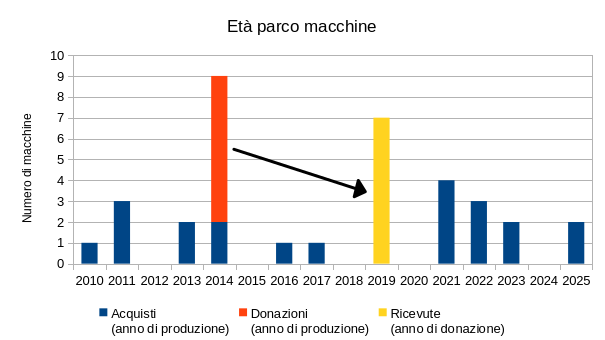
Età parco macchine
Nel 2019 il Dipartimento ha ricevuto una decina di macchine dal CERN, che venivano dismesse per favorire un ricambio dell’hardware, liberando gli armadi nel datacenter. Alcune di queste macchine avevano dei problemi, ma 7 sono ancora funzionanti e in uso; nell’elenco precedente, sono le macchine QuarkX.
Per queste macchine viene riportata l’età effettiva delle macchine, in rosso, e anche l’anno del loro ingresso in Ateneo, in giallo. La freccia indica che sono le stesse macchine, messe a disposizione in un momento successivo, e non altre macchine.